


Editor's note: this story first appeared in the January 2026 issue of Chess Life magazine. Consider becoming a US Chess member for more content like this — access to digital editions of both Chess Life and Chess Life Kids is a member benefit, and you can receive print editions of both magazines for a small add-on fee.
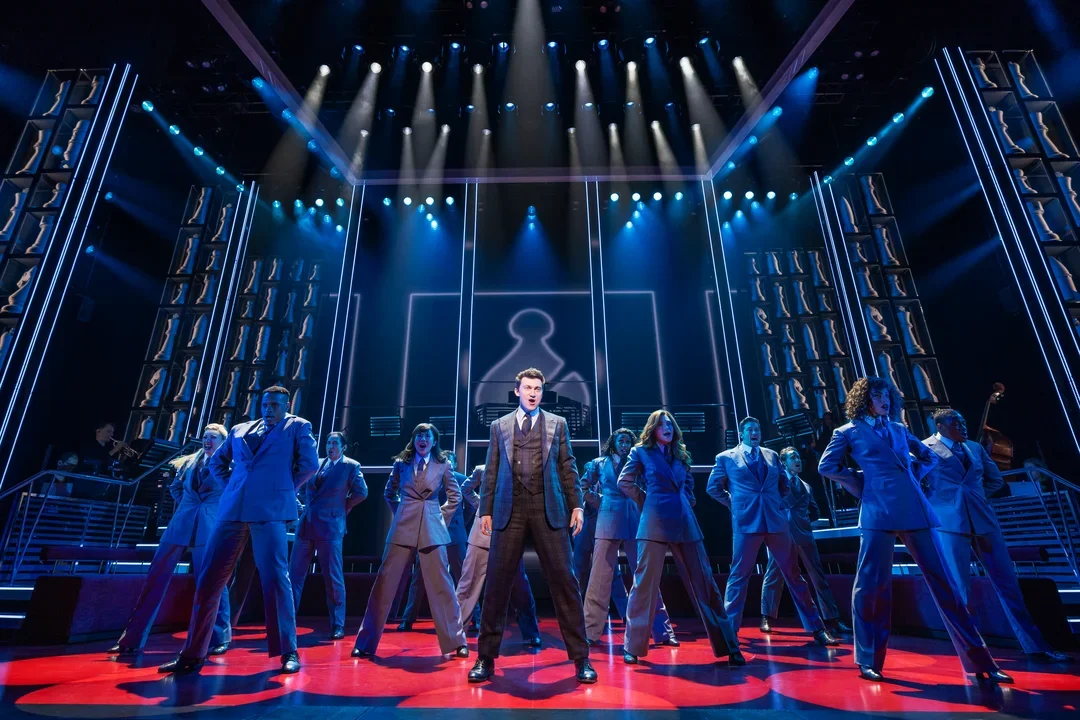
Nearly 40 years later, a reworked Chess returns to Broadway.
Danny Strong felt like something wasn’t adding up.
In 2015, he was watching a YouTube video of a 2008 concert production of the musical Chess, with songs by Tim Rice and ABBA’s Benny Andersson and Bjorn Ulvaeus. He loved the album, which came out in 1985; he also loved Rice’s previous efforts, 1970’s Jesus Christ Superstar and 1976’s Evita.
But those earlier hit albums were made into musicals that enjoyed extended runs on Broadway and played all over the world for years, as well as popular movie adaptations. Chess, on the other hand, closed in a Broadway heartbeat — 68 performances. There was no tour. There was no film.
So what happened? That’s why Strong was watching.
“It’s this famous white whale of musical theater,” Strong says — “one of the great rock scores for a show that famously doesn’t work. And I watched it to see: Why doesn’t it work?”


Strong, a two-time Emmy winner for Game Change and a co-creator of the TV show Empire, began “naturally breaking down what I thought the problems were.” At first, he says, it was just reflex — “that’s my wont in life as a writer” — but eventually he began coming up with ideas. “And I thought, you know, I maybe could actually fix or improve this show.”
Strong emailed one of his favorite directors: Michael Mayer, winner of five Tony Awards for musicals and plays including American Idiot and Spring Awakening. Strong asked Mayer whether he’d be interested in taking a look at the concert and coming up with new ideas for Chess. Unbeknownst to Strong, Mayer had actually been in the audience at the Royal Albert Hall and replied simply, “I’m in.”
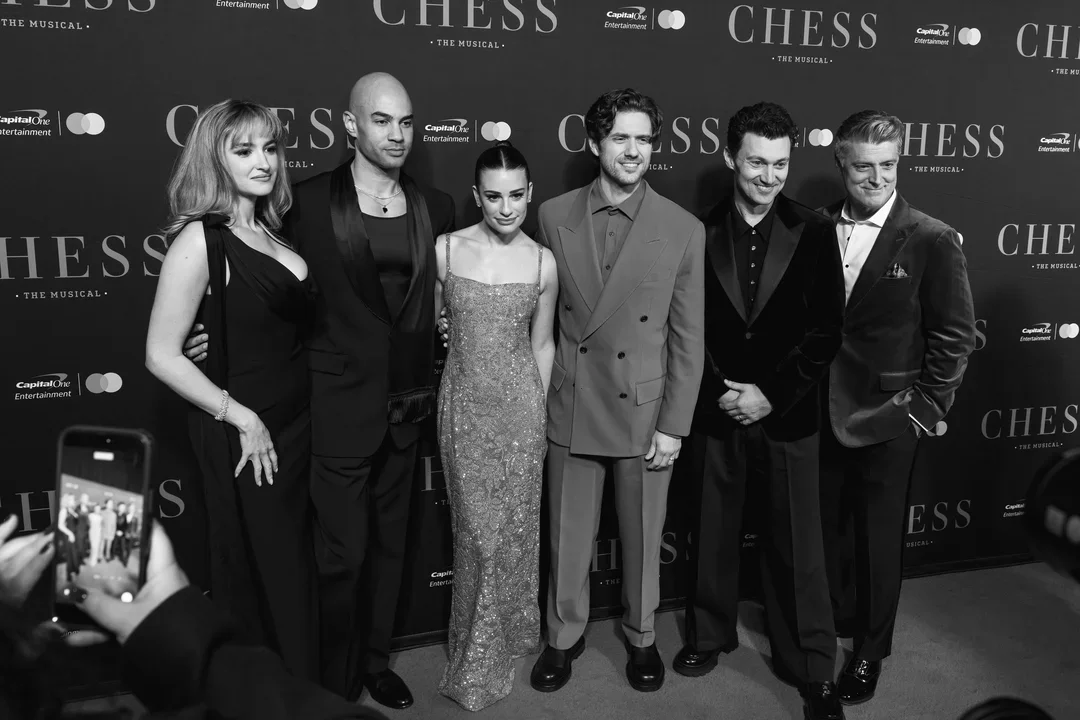
A mere 10 years and many workshops later, a revamped version of Chess opened on Broadway at the Imperial Theatre — the same venue as its ill-fated run in 1988.
Straightening out the story
Chess, set in the 1980s, tells the story of Freddie Trumper, an American grandmaster; Anatoly Sergievsky, a Soviet GM; and Florence Vassy, who begins the show as Trumper’s second and girlfriend. Meanwhile, the CIA and KGB operate in the background, and the chessic and ideological battles force difficult choices from the three main players.
The show had several incarnations and revisions in the 1980s in London and New York — sometimes Freddie begins as the world champion and Anatoly the challenger; sometimes it’s the other way around. Sometimes there’s one world championship match; sometimes there are two. Sometimes Florence, a Hungarian national who escaped the Soviet repression of 1956, is reunited with her long-lost father; sometimes she isn’t.
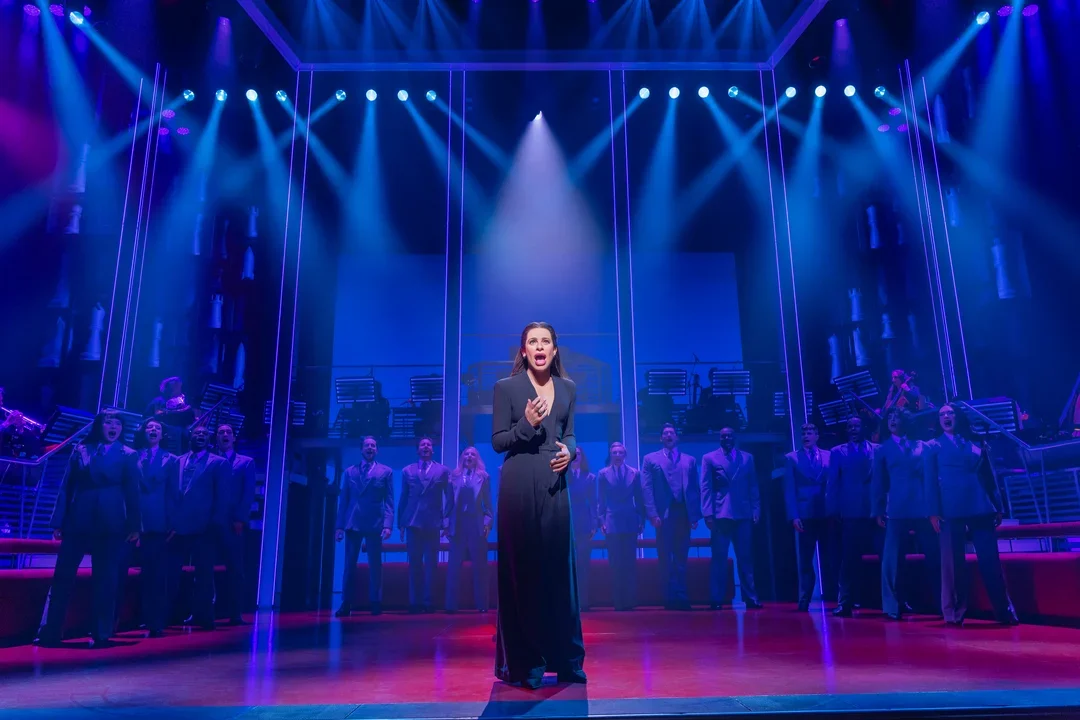
It’s got the wonderful score, with hit songs such as “One Night in Bangkok” and “I Know Him So Well,” but the fact that the songs could be worked into so many different shapes by the story isn’t really a great sign. The New York Times said in November that Chess was historically “a musical as adored as it is infuriating.”
“Danny didn’t come up with a story from whole cloth,” Mayer says, “but he did have to figure out a way to make a story where these songs would all actually make some level of sense.”
The new Chess features two world championship matches, first between Trumper and Sergievsky and then between Sergievsky (now a defector) and the new Soviet hope Viigand.
Some of the songs are reordered, and the two players each reveal their emotional core early on, while Florence sets the worldview in Act I (“nobody’s on nobody’s side”). The show foregrounds the triangle among the three main characters and ties the CIA – KGB machinations to specific Cold War confrontations (the SALT II talks in Act I, the brinksmanship of the 1983 Able Archer controversy in Act II); both secret agencies try to influence the result of the matches. All the while, the action is narrated and explained by The Arbiter, whose role is expanded in Strong’s retelling to act as the audience’s guide to the worlds colliding (see the interview with actor Bryce Pinkham on page 35).
“The artwork that I think this most reminds me of is Casablanca,” Mayer says. “Because it’s the love triangle, and they all make the sacrifice to do the right thing, even though it they end up heartbroken. And you know what? I’ll take it.”
Looking back
Whereas the earlier productions of Chess were written and produced just a few years after the events they’re alluding to, the new version has 40 years of perspective to look back on.
“That was one of the first things Tim Rice said to me when I met with him,” Strong says — “he said, ‘You know, I was writing this show and creating as these events were happening, as opposed to what you could do, which is reflect upon them from a bird’s eye point of view.’”
Bryce Pinkham, who plays The Arbiter, points out that at one moment he tells the audience, “Our players are about to collide with one of the most dangerous moments in world history that you’ve never even heard of until now.” That’s the Able Archer standoff, during which the Soviet Union was convinced that the U.S. was setting up an attack and planned to respond in kind. It reached its peak Nov. 12, 1983, which in Act II of Chess coincides with the last Sergievsky – Viigand game, the finale of a match whose result will influence the nuclear confrontation.
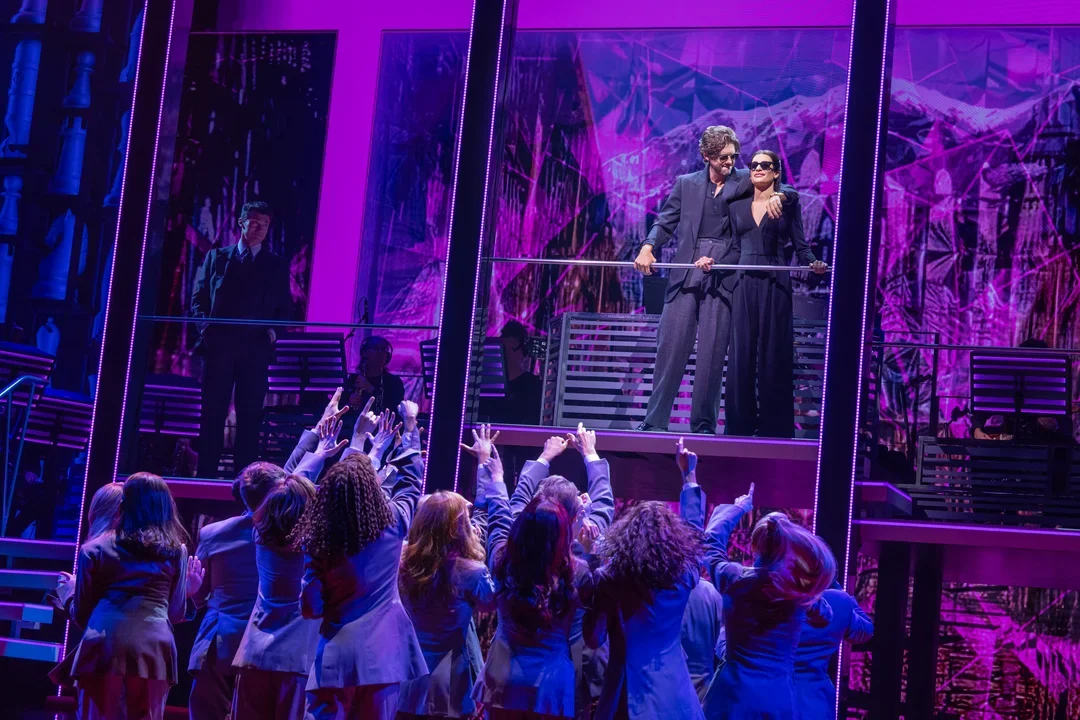
“I think we have a lot of fun with how preposterous the idea is that in any world, a chess tournament would have global impact on a Cold War manipulation and vice versa,” Mayer says, “because people are so taken with the way that these characters are revealing themselves through songs and a clear, if, again, preposterous set of circumstances. You can follow it and you can enjoy it. So I think that’s something that Chess didn’t have before.”
The Arbiter alludes to the fact that some don’t believe the Able Archer incident happened at all, and Pinkham notes that “it’s juxtaposed with a chessboard — which is like what Freddie’s always saying: The game is true. You play the game to win, and if you play that way … there’s nothing untrue about what happens on the board. And there’s something comforting to that in our world today.”
How about the game?
One of the first things a chessplayer would notice is that there’s very little chess on stage. Two games, one from each match, are depicted by actors speaking their moves into microphones along with updates on their emotional states — a pretty compelling portrayal of the changes players can go through during a game.
But there’s no board, no set, on stage at any point — only large decorative pieces going up the sides of the stage. And the creators, both of whom say they played the game as kids but never took it up seriously as adults, say that was intentional. “[Chess] is the opposite of theatrical … and I say this with full respect to the game,” Mayer says. Strong adds that adding a physical depiction of a chess game was never a consideration: “We’ve actually never even had this discussion.”

“We’re watching the KGB and the CIA playing chess with our characters,” Mayer adds; “we’re actually watching that chess game at lived out on the stage, as well as the literal chess matches that they play. So I feel like it’s the best way to give an audience who might not be chessplayers an understanding of what the skill set is to be a chessplayer.”
While they don’t show the game, and they fall into the some of the traps so common to fictional portrayals of chess (opening choices are portrayed as deep clues to the players’ non-chess psyches, for example), Mayer says they communicate the essence of chess through the essence of Chess: “It’s the word that to me defines chess, and that’s sacrifice. I don’t know many games where the whole concept of sacrificing your pieces to accomplish something greater is part of the DNA of the game. … And it’s so potent to the story, and I think that’s something that Danny has really delved into.”
Speaking shortly before the show’s official opening, Strong says he’s happy with what he, Mayer, and the cast have achieved.
“People … do Chess in concert, right? They rarely do the show. And if we can make this work, this can be done all over the world, [like] Jesus Christ Superstar and Evita, Tim Rice’s two shows right before this. … I just always thought this deserves to be done, because I think the score is just as good as those two scores. I love those two shows, and I just thought this deserves to be done the way those shows deserve to be done, and that was the mission. And, you know, I think we might achieve it now.”
A Talk With the Arbiter
A conversation with actor Bryce Pinkham
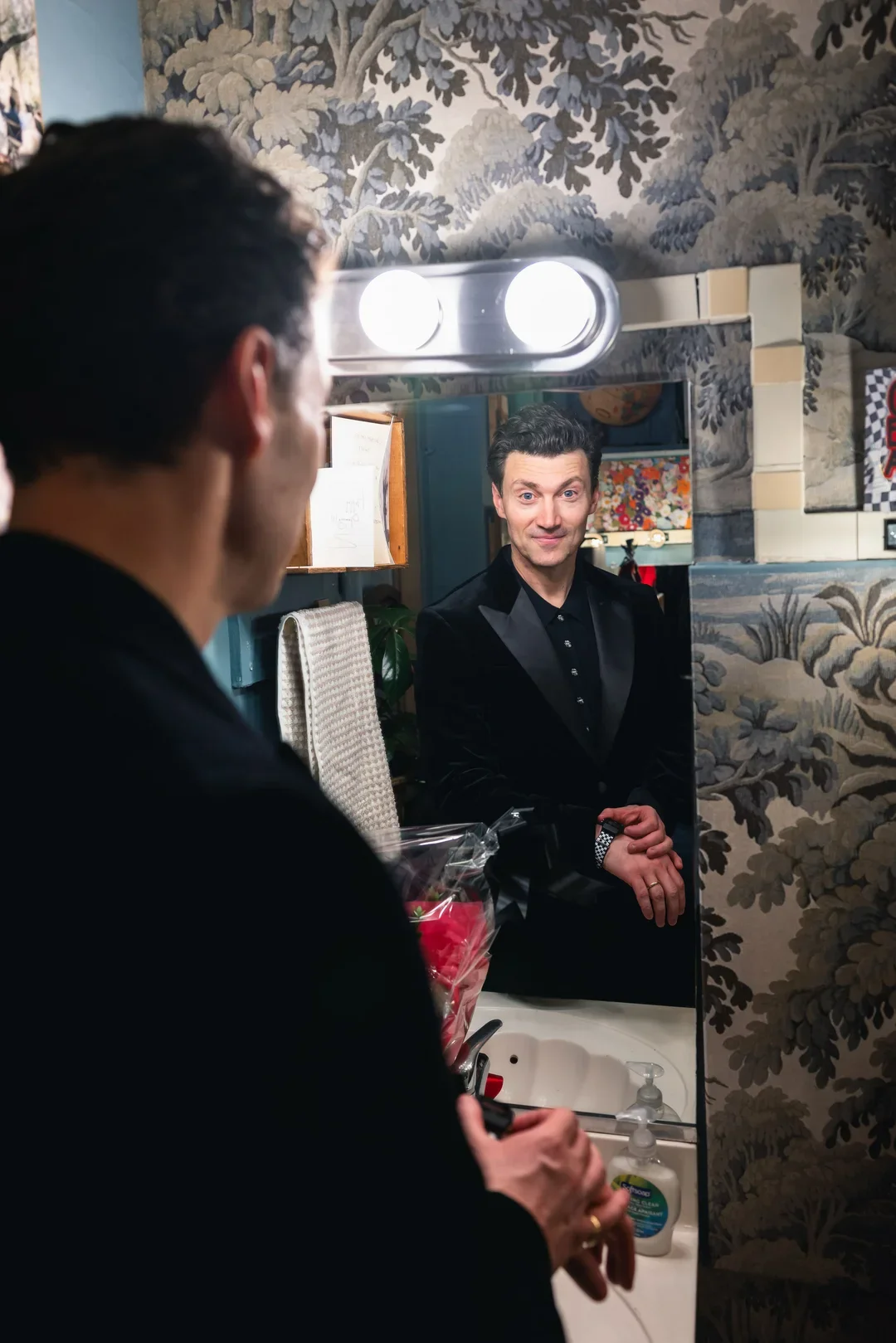
The Broadway revival of Chess includes a few structural changes to the script, but the biggest (and most successful) is the expansion of the role of The Arbiter. From a gallivanting, gloating umpire with his own theme song (“The Arbiter,” of course), the role now encompasses acting as the audience’s guide to the world of the musical and to the sometimes-abstruse chessic and Cold War maneuvers at work. Sometimes it requires a lot of explaining; sometimes it requires literally making fun of the plot twists. It’s a tall order, but Bryce Pinkham says he was ready to take it on.
Pinkham, a Tony Award nominee for A Gentleman’s Guide to Love and Murder and the voice of Stolas in the web series Helluva Boss, says writer Danny Strong conceived of The Arbiter as a “sort of narrator, host, hypnotist even, that can help guide the audience through what otherwise might require a lot of attention to detail to follow. So it’s basically taking that worry away from the audience members saying, ‘I got you; I’m going to guide you through this,’ so that they can simply enjoy the fantastic music and what I think is an improved story.”
That sounds like it comes with pressure, though Pinkham says “I wouldn’t call it pressure, but I would certainly call it responsibility, and I revel in that responsibility. And I do take that very seriously, because I think the success of this iteration depends on improved intelligibility, and I think that The Arbiter is sort of part and parcel to that.”
The interactions with the audience keep him on his toes — some asides to the audience work better than others, and there are variations in that response every night — but Pinkham says that’s how he likes it: “That’s part of what keeps you on your toes and keeps the adrenaline that you need pumping through your veins.”
He’s been the only Arbiter in this iteration of the musical, which dates back to 2018, and says he’s been honored to be part of the process. “A lot of The Arbiter that now exists was born out of a collaboration between a specific actor and a specific writer and director. And we spent a lot of time on the sidelines, workshopping different things, and I’ve ad-libbed in rehearsal, things that they’ve kept and things that they’ve thrown away. I think that that sort of ‘best idea wins’ attitude is what makes things grow better and better … you know, it’s a great relationship to have.”

Pinkham learned the game from his grandfather and, thanks to his night job, is teaching the game to his kids. He also has a family history with Chess: His father-in-law, Sandy Strallen, was in the original company for the 1986-88 production of the show on London’s West End. Pinkham says Strallen “has stories to tell of that time, and some of my wife’s earliest memories are going to the theater and listening to Chess as her dad was rehearsing.”
That makes this experience all the more gratifying: “The connection to my father-in-law, and my memory playing chess with my grandfather as a child, which I hear echoed in this story every night, and passing a game on and the show on to my kids — feels like a real, fulfilling full-circle, or maybe I should say all-64, moment for me.”


Categories
Archives
- October 2026 (7)
- September 2026 (27)
- August 2026 (28)
- July 2026 (36)
- June 2026 (32)
- May 2026 (30)
- April 2026 (33)
- March 2026 (27)
- February 2026 (24)
- January 2026 (24)
- December 2025 (27)
- November 2025 (29)
- October 2025 (39)
- September 2025 (27)
- August 2025 (29)
- July 2025 (43)
- June 2025 (25)
- May 2025 (24)
- April 2025 (29)
- March 2025 (29)
- February 2025 (20)
- January 2025 (24)
- December 2024 (34)
- November 2024 (18)
- October 2024 (35)
- September 2024 (23)
- August 2024 (27)
- July 2024 (44)
- June 2024 (27)
- May 2024 (31)
- April 2024 (51)
- March 2024 (34)
- February 2024 (24)
- January 2024 (26)
- December 2023 (29)
- November 2023 (26)
- October 2023 (37)
- September 2023 (27)
- August 2023 (37)
- July 2023 (47)
- June 2023 (33)
- May 2023 (37)
- April 2023 (45)
- March 2023 (37)
- February 2023 (28)
- January 2023 (31)
- December 2022 (23)
- November 2022 (32)
- October 2022 (31)
- September 2022 (19)
- August 2022 (39)
- July 2022 (32)
- June 2022 (35)
- May 2022 (21)
- April 2022 (31)
- March 2022 (33)
- February 2022 (21)
- January 2022 (27)
- December 2021 (36)
- November 2021 (34)
- October 2021 (25)
- September 2021 (25)
- August 2021 (41)
- July 2021 (36)
- June 2021 (29)
- May 2021 (29)
- April 2021 (31)
- March 2021 (33)
- February 2021 (28)
- January 2021 (29)
- December 2020 (38)
- November 2020 (40)
- October 2020 (41)
- September 2020 (35)
- August 2020 (38)
- July 2020 (36)
- June 2020 (46)
- May 2020 (42)
- April 2020 (37)
- March 2020 (60)
- February 2020 (38)
- January 2020 (45)
- December 2019 (34)
- November 2019 (35)
- October 2019 (42)
- September 2019 (45)
- August 2019 (56)
- July 2019 (44)
- June 2019 (35)
- May 2019 (40)
- April 2019 (48)
- March 2019 (61)
- February 2019 (39)
- January 2019 (30)
- December 2018 (29)
- November 2018 (51)
- October 2018 (45)
- September 2018 (29)
- August 2018 (49)
- July 2018 (35)
- June 2018 (31)
- May 2018 (39)
- April 2018 (31)
- March 2018 (26)
- February 2018 (33)
- January 2018 (30)
- December 2017 (26)
- November 2017 (24)
- October 2017 (30)
- September 2017 (30)
- August 2017 (32)
- July 2017 (27)
- June 2017 (32)
- May 2017 (26)
- April 2017 (37)
- March 2017 (28)
- February 2017 (30)
- January 2017 (27)
- December 2016 (29)
- November 2016 (24)
- October 2016 (32)
- September 2016 (31)
- August 2016 (27)
- July 2016 (24)
- June 2016 (26)
- May 2016 (19)
- April 2016 (30)
- March 2016 (37)
- February 2016 (27)
- January 2016 (33)
- December 2015 (25)
- November 2015 (23)
- October 2015 (16)
- September 2015 (28)
- August 2015 (28)
- July 2015 (6)
- June 2015 (1)
- May 2015 (2)
- April 2015 (1)
- February 2015 (3)
- January 2015 (1)
- December 2014 (1)
- July 2010 (1)
- October 1991 (1)
- August 1989 (1)
- January 1988 (1)
- December 1983 (1)