


On his personal Substack, Lit and Chess, FM Andy Lee reflected on his thought process after "flash-annotating" for Chess Life Online. His insight is astounding and will give readers insight into, in Lee's own words, "How the sausage is made." With his permission, we are republishing his essay here, lightly edited for style. You can read it in its original form here.
A couple weeks ago I was invited to contribute a set of annotations from rounds three and four of the 46th FIDE Olympiad for Chess Life Online. The deal was that I would focus on the performance of the American teams by annotating some key games and then pick out some interesting moments from other top teams and notable players. The catch is that the set of annotations had to be done in 48 hours. In my case, that 48 hours got whittled down to about six, as I had to work during the Friday round, cook a bunch of meals for my family both days, take my seven-year-old to a birthday party, finish the novel my book club was reading, etc. I took the job, knowing that I was going to have to rush, but I don’t think I was fully prepared for the challenges that creating these annotations entailed.
I sometimes enjoy writing articles where I take the flash reports from Chess.com or elsewhere and expand upon a critical moment in one or two of the games to make my own annotations look good by way of comparison. Here’s an example from Wijk aan Zee, in which I used Colin McGourty’s write-up as a starting point to investigate a couple positions. The purpose of my piece was think about how deep chess is and how hard this is to capture in a flash report or an eval graph, and I tried to be fair to McGourty, who was writing about the entire round.
Now that I found myself on the other side of things, I realized that I was going to have to sort through an awful lot of games: The Olympiad is huge! I’ve read enough of these reports to know the general style, but I found that I had to make a lot of judgment calls along the way, more than I expected at the start. If you’re interested in checking out the finished product before getting into how the sausage was made, you can find the article here.
As with any writing project, the first thing to consider is your audience. I’m fond of doing deep dives into complicated games, but the average reader of a report about a couple Olympiad rounds is going to be skimming through the material to get a sense of the twists and turns and critical moments, so my goal was to curate the games rather than dissect them. I also had to come to terms with the fact that the machine was going to be doing a lot of heavy lifting. I would pick the games, and it would go looking for critical moments that I could write about for a human audience.
When I started thinking about the task this way — human games, machine variations, human explanation — I realized that I was really doing the work of a translator. It goes without saying that a human being approaches chess completely differently from the version of Stockfish running on my MacBook, which is again very different from the (potentially distracted) human chess enthusiast skimming through my notes to the games.
The idea of translation also suggested some important principles, which I tried to adhere to throughout the process:
1. Pick games that have an element that can be worked into a memorable narrative.
I was lucky enough to have a lot of interesting games to choose from, including a very difficult round four struggle between GM Fabiano Caruana and GM Vasyl Ivanchuk. In the opening, Ivanchuk chose to bury his own bishop behind his pawn center, like so:
It was a cool idea that caused White some real problems, but in terms of narrative I was very happy to see Caruana make a similar decision to consolidate his extra piece later in the game:
What could have been yet another Giuoco Piano was suddenly transformed into something memorable: the battle of the buried bishops.
I had similar good luck when finding a game in the Women’s event in which IM Shri Savitha sacrificed her knight not once but twice on f6 to take down her Mongolian opponent — instant memorable narrative.
2. If precision is going to turn you into a jerk, be less precise.
Even the best human games lose some of their shine when held up against computer analysis. This is a bigger issue in the Olympiad, as players often have to play risky moves when the team situation requires a win. The players on both American teams are stronger than I am, and it’s not reasonable for me to pick at their decisions from the comfort of my living room.
My rule of thumb was to explore the decisions that the players made in the context of the match itself, particularly when it felt likely that they were aware that a decision was at hand. For example, in his wild round four comeback win against GM Roman Dehtiarov, GM Levon Aronian was confronted with an important choice:
The engine approves of White’s plan of tying Black to the defense of his f-pawn, recommending 34. … Kg8 35. Bh5 Rf8 with equality. Aronian played 34. … f5 instead, a move that the engine does not approve of but the clear choice if you feel like you need to stay active if you’re going to have a chance to win the game for your team. In the end Aronian was justified as he won the game, and I gave his … f7-f5 idea a “!?” instead of “?!.”
I had a similar decision to make as I was annotating IM Tatev Abrahamyan’s Round 4 victory. She had played an excellent positional game and only needed to find one more accurate variation to bring home the point:
The best move is 38. Nf5!, combining a mating attack with pushing the d-pawn. Black can try 38. … Bxf2 39. d6 Qb2, but then 40. Qc4! is the killer. Tatev played the safer-looking 38. Nc4 instead, which allowed 38. … Qb4 39 d6 Bd4 and Black is closer to equalizing than she had any right to be.
I certainly understand the impulse to take the quieter path when you have a stable advantage, but it turned out that White’s advantage was not so great once the bishop landed on d4. I also felt like Abrahamyan would normally find 38. Nf5! without too much trouble, so I compromised and gave 38. Nc4 a “?!” mark.
3. Don’t let the engine take you too far into the weeds.
It can be very satisfying to find a long, complicated computer variation that reveals something hidden in the position. The problem is that it’s all too possible that the idea was hidden from the players as well — if they had seen it, they probably would have played it! I generally avoided temptation to show impossibly flashy variations, with the exception of the game below:
Here, GM Hans Niemann played the very normal-looking 20. … Qe6, planning to pick up the e5-pawn next, but the machine is screaming for 20. … Qg4!. I did not understand the point of this move at first, but I decided to make some mediocre human moves to get a sense of what the computer was up to. It turns out that 20. … Qg4! is a very deep piece of prophylaxis. By controlling d4, the white rook cannot leave the d-file to offer a trade on f1. If 21. Rd4, Black plays 21. … Qh3, controlling f1 a second time and again avoiding a rook trade.
This begs the question: Why is Black so keen on keeping the rooks on the board? There are many variations, which I pared down to one illustrative example: 22. Rdd1 (renewing the idea of bringing a rook to f1) 22. … Bh4!!
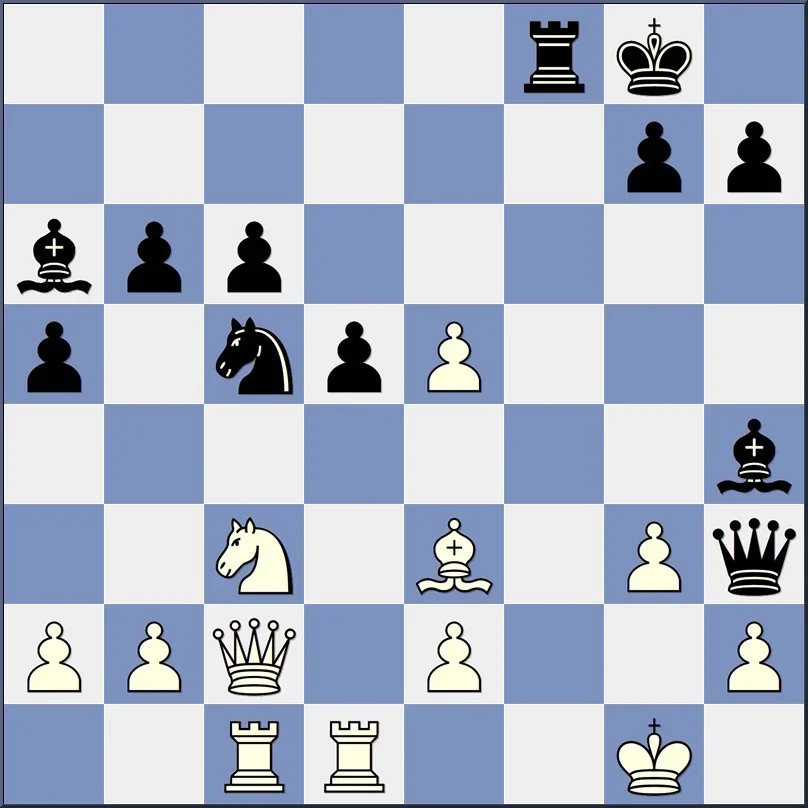
With his pieces jumbled on the queenside, White is helpless against the threatened sacrifice on g3, and the game would have quickly come to an end. In keeping with the previous principle, I’m not sure that I would expect many people to find 20. … Qg4, but Niemann is a self-proclaimed genius, so I gave his Qe6 a “?!.”
Another opportunity to get lost in computer analysis occurred in the aforementioned Aronian game:
The position is obviously difficult, and the computer was not entirely happy with many moves played by either player to get to this point. Rather than litter the field with question marks and unfathomable computer lines, I saved a single comment for White’s next move, 50 Kf4?, noting that, “This is an unforced error that sends the king into the mating net.” The mating net is an idea that humans can quickly understand, and the basic idea was borne out in the game, which concluded 50. … Rc3 51. Qd7 Rf3+ 52. Kg4 h5+ 53. Kxh5 Rg3, with the bishop coming to f3 coming next.
4. The audience is best served by short, human variations.
Almost every chess player misses tactical opportunities over the course of a game — chess is really difficult! — and highlighting those opportunities is instructive for all readers. GM Wesley So’s third round victory illustrates this principle nicely:
Black’s last move was a blunder, but in the spirit of the second principle, it was an understandable, human blunder. If not for 26. Qxe6+!, Black would be winning an Exchange and the game, and he was probably really excited to take down So before getting hit with a minor brilliancy. In any case, 26. … Qxe6 27. Rxg7+ Kf8 28. Ng6 mate is the perfectly sized tactical morsel, and a mini-narrative (who doesn’t love a queen sacrifice) in itself.
The game continued 26. … Kh7 27. Qf5+ Kg8 28. Qe6+ Kh7 29. Qf5+ Kg8:
Wesley played 30. f4!, and I missed the chance to point out that 30. Rxg7+?? Qxg7 31. Bxg7 loses to 31. … Re1 mate, another nice little burst of tactics that you could imagine someone missing because the rook was initially blocking the bishop’s coverage of h2. There followed 30. … Qe1+ 31. Kh2 Bf8 and here I did manage to point out that 32. Qxf6?? loses to 32. … Qxg3+!, eliminating the rook and winning back the queen.
I hope that these examples demonstrate the interesting balancing act between computer analysis and human insight that go into the creation of these tournament reports. It’s harder than it looks, and you’re pretty much guaranteed to leave out something important. I had to repeatedly tell my brain that it couldn’t turn itself off and let the engine do all the work — it’s the translator’s job to think about how the text (in this case, the games themselves) can be shaped into something meaningful for the audience. If I did it about fifty more times, I think I’d probably get the hang of it.


Categories
Archives
- October 2026 (5)
- September 2026 (27)
- August 2026 (28)
- July 2026 (36)
- June 2026 (32)
- May 2026 (30)
- April 2026 (33)
- March 2026 (27)
- February 2026 (24)
- January 2026 (24)
- December 2025 (27)
- November 2025 (29)
- October 2025 (39)
- September 2025 (27)
- August 2025 (29)
- July 2025 (43)
- June 2025 (25)
- May 2025 (24)
- April 2025 (29)
- March 2025 (29)
- February 2025 (20)
- January 2025 (24)
- December 2024 (34)
- November 2024 (18)
- October 2024 (35)
- September 2024 (23)
- August 2024 (27)
- July 2024 (44)
- June 2024 (27)
- May 2024 (31)
- April 2024 (51)
- March 2024 (34)
- February 2024 (24)
- January 2024 (26)
- December 2023 (29)
- November 2023 (26)
- October 2023 (37)
- September 2023 (27)
- August 2023 (37)
- July 2023 (47)
- June 2023 (33)
- May 2023 (37)
- April 2023 (45)
- March 2023 (37)
- February 2023 (28)
- January 2023 (31)
- December 2022 (23)
- November 2022 (32)
- October 2022 (31)
- September 2022 (19)
- August 2022 (39)
- July 2022 (32)
- June 2022 (35)
- May 2022 (21)
- April 2022 (31)
- March 2022 (33)
- February 2022 (21)
- January 2022 (27)
- December 2021 (36)
- November 2021 (34)
- October 2021 (25)
- September 2021 (25)
- August 2021 (41)
- July 2021 (36)
- June 2021 (29)
- May 2021 (29)
- April 2021 (31)
- March 2021 (33)
- February 2021 (28)
- January 2021 (29)
- December 2020 (38)
- November 2020 (40)
- October 2020 (41)
- September 2020 (35)
- August 2020 (38)
- July 2020 (36)
- June 2020 (46)
- May 2020 (42)
- April 2020 (37)
- March 2020 (60)
- February 2020 (38)
- January 2020 (45)
- December 2019 (34)
- November 2019 (35)
- October 2019 (42)
- September 2019 (45)
- August 2019 (56)
- July 2019 (44)
- June 2019 (35)
- May 2019 (40)
- April 2019 (48)
- March 2019 (61)
- February 2019 (39)
- January 2019 (30)
- December 2018 (29)
- November 2018 (51)
- October 2018 (45)
- September 2018 (29)
- August 2018 (49)
- July 2018 (35)
- June 2018 (31)
- May 2018 (39)
- April 2018 (31)
- March 2018 (26)
- February 2018 (33)
- January 2018 (30)
- December 2017 (26)
- November 2017 (24)
- October 2017 (30)
- September 2017 (30)
- August 2017 (32)
- July 2017 (27)
- June 2017 (32)
- May 2017 (26)
- April 2017 (37)
- March 2017 (28)
- February 2017 (30)
- January 2017 (27)
- December 2016 (29)
- November 2016 (24)
- October 2016 (32)
- September 2016 (31)
- August 2016 (27)
- July 2016 (24)
- June 2016 (26)
- May 2016 (19)
- April 2016 (30)
- March 2016 (37)
- February 2016 (27)
- January 2016 (33)
- December 2015 (25)
- November 2015 (23)
- October 2015 (16)
- September 2015 (28)
- August 2015 (28)
- July 2015 (6)
- June 2015 (1)
- May 2015 (2)
- April 2015 (1)
- February 2015 (3)
- January 2015 (1)
- December 2014 (1)
- July 2010 (1)
- October 1991 (1)
- August 1989 (1)
- January 1988 (1)
- December 1983 (1)