

For Black History Month, Chess Life Online has so far spotlighted the accomplishments of two Black players (Jacorey Bynum and IM Tani Adewumi), in addition to year-round coverage focusing on American chessplayers from diverse backgrounds.
Today we shift attention to two prominent Black coaches: Detroit’s Derek Wilder and New York City’s WFM Perpetual Ogbiyoyo.
Originally, these were going to be two separate profile pieces, highlighting the individual accomplishments, experiences, and philosophies of each coach. But, taking the two interviews (see below) together, what becomes clear is that there is no single "best" or "right" coaching philosophy. What makes each of Wilder and Ogbiyoyo excellent coaches with impressive track records is that they each pour their whole selves and backgrounds into their teaching.


Wilder coaches the chess teams for Chrysler Elementary School, Ralph J. Bunche Preparatory Academy, and, as of this year, Martin Luther King Jr. Senior High School. Ogbiyoyo began coaching in Nigeria before moving to the U.S., and now coaches through the Impact Coaching Network (ICN) at PS 282, PS 20, and PS 130M in New York City, where she has also coached several other programs, including a PS 59 team that won the K-1 All Girls Championship.
Wilder’s Chrysler team won back-to-back state titles in the Elementary (K-5) Reserve section of the Michigan State Scholastic Championship in 2019 and 2020. His other accomplishments include a Detroit Metro Scholastic Championship with his Bunche team, and several of his students have placed towards the top of “under” sections in national events.
Ogbiyoyo’s most recent accomplishment as a coach is her PS 20 team’s victory in the Brooklyn Cup (in just the program’s second year of existence). She has guided numerous players who were just starting out to US Chess ratings over 1000, including one student who went undefeated at last year’s SuperNationals VIII. Of her teaching philosophy, she says, “Across every space, the objective is the same. Develop thinkers. Develop competitors. Develop confidence.”
Of course, both Wilder and Obgiyoyo are accomplished players, too. In 2022, Ogibyoyo led the University of Port Harcourt women’s chess team to victory at the Nigerian University Games, establishing them as the strongest female university team in Nigeria that season. That same year, Wilder achieved a national rating over 2000 for the first time in his playing career.
Chess Life Online caught up with both coaches to share their experiences in their own words. The below interviews were conducted separately and edited for clarity.
Chess Life Online (CLO): What’s your favorite thing about being a chess coach?
Derek Wilder (DW): My favorite thing about being a chess coach is the look on the kids’ faces when something we practice works over-the-board in a tournament. That’s the best feeling ever.
Perpetual Ogbiyoyo (PO): Chess reveals character. When a child loses a painful game and chooses to return stronger, they are building more than rating points. They are building resilience. I have seen shy students become assertive competitors and frustration turn into discipline. The board becomes a mirror, and through it, they learn to trust their thinking.

CLO: Tell me what your students are like. Do most of them start already knowing how to play chess? What do they like about chess?
DW: My students have different personalities. For most of them, I teach chess from scratch. It’s like recording a great musical track when something just clicks. What they love most is traveling to see different parts of the country, and they know they have to perform well and take chess seriously to get to travel, so they work very hard.

PO: Some students begin without knowing how the pieces move. Others arrive rated between 500 and 1000. What unites them is potential.
They love mastery. Seeing what others miss. Earning their wins. Chess gives them ownership, and that accountability builds maturity.
CLO: What are some of the things you’re most proud of as a coach?
DW: I have a Spirit of Detroit award given to me from the City Council, which means I was honored for an outstanding achievement or service to the citizens of Detroit for my coaching.
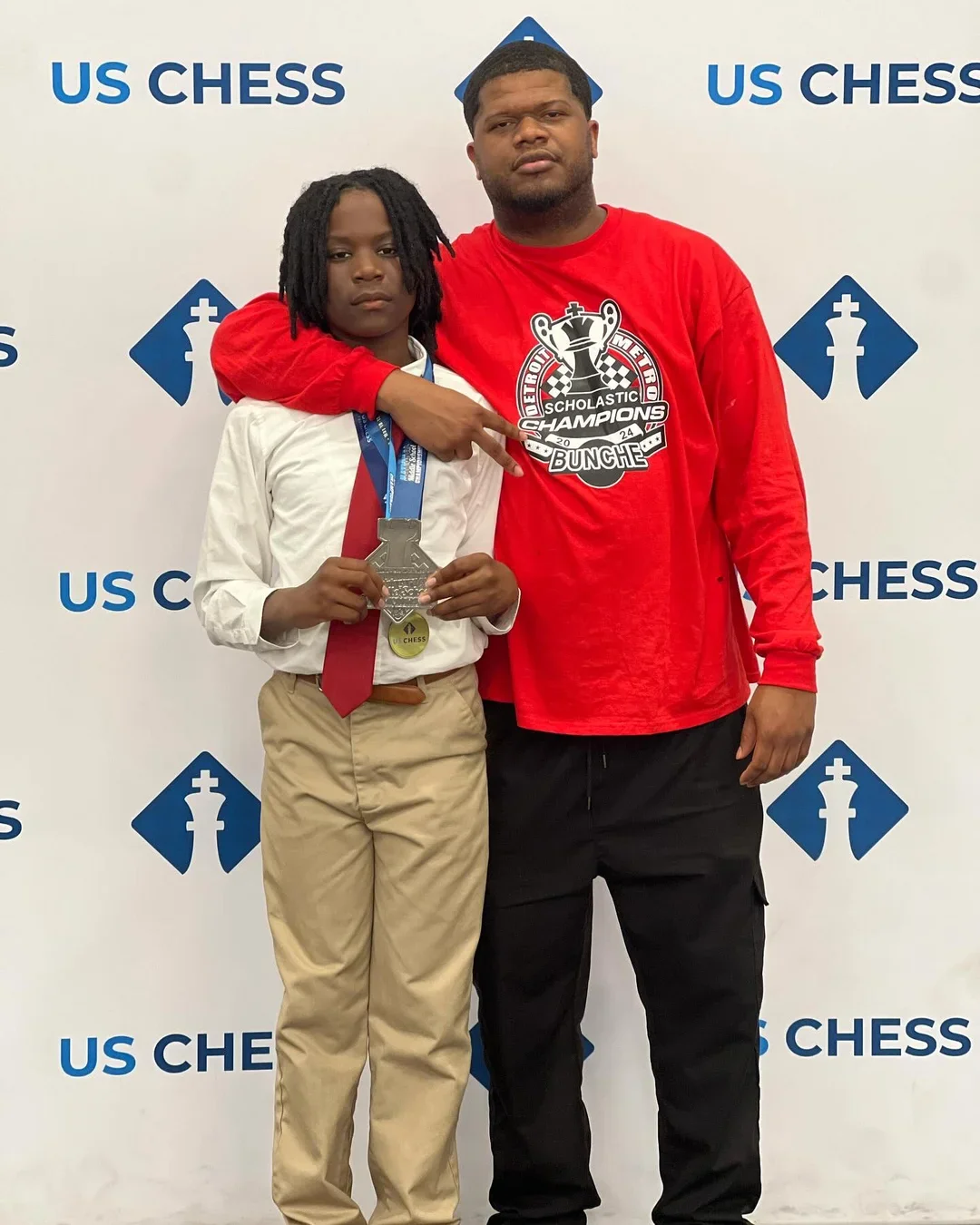
As far as individual students, Mekhi Howard tied for ninth in the K-5 Under-1200 section of the National Elementary School Championships in 2023. The year before, he tied for 12th in the K-5 Under-900 section, so seeing him go up a section and beat his result was really special. He has a promising future! There's also Delano Green (pictured above), who finished second in the K-8 Under-900 section in Atlanta in 2024 with an undefeated 6/7 score.
PO: I am proud of building legacy, not moments. From leading a university team in Nigeria to preparing elementary students in New York for state and national competition, the pattern is intentional development over time.
As the founder of Promoting Queens, I am deeply committed to expanding access for girls who are often underestimated. Talent is universal. Opportunity is not. When girls are trained seriously and supported consistently, they excel. Creating that environment is not a side project. It is part of my life’s work.
CLO: How did you get into playing chess? Who were some of your first teachers or mentors?
DW: I got into playing chess in elementary school. We had a chess club, but I didn't get serious about it until middle school. I had a middle school coach named Paul Grams, and he was 1900 at his peak. Then coaches and mentors like coach Bryan Barnette, he is a father figure to me and a coach. Then friends like the late Joseph Gadson, Chris Sims, Kameron Tolliver, D'Angelo Watkins, and more. It’s a real community in Detroit.
PO: I discovered chess at 19 and committed fully. Within two years, I earned my WFM title and became a two-time Nigerian Women’s Chess Champion.
One of my earliest coaches was CM Benjamin Omorere, who prepared me for my first major tournament. Before that, I was largely self-taught, improving through loss, study, and persistence. I later on worked with GM Pawel Teclaf. Watching players like Judit Polgár reinforced a truth I now pass on. When belief meets preparation, barriers fall.
CLO: What advice do you have for other chess players thinking about getting into coaching?
DW: My advice for anyone who wants to get into coaching is to do it for the love of the kids first. The wins and losses are going to come but do it for the love of the kids because a lot of them need mentorship and love.
PO: Coaching is stewardship. It is not about showing your strength. It is about building someone else’s confidence. Build systems. Demand discipline. Speak belief consistently.

CLO: Is there anything else you want to say about yourself, your goals, or your background?
DW: Chess saved my life coming from my background. I’m an inner-city kid, from “the hood” as we call it. Chess kept me out of jail. It kept me out of trouble.
Most of my peers didn't get these opportunities I had from chess, and that's why I give back to the inner-city kids in Detroit because they remind me of myself. They may not all become an expert like me, but they can see me and believe that they can overcome hardships in life.
PO: My journey spans continents, from discovering chess in Nigeria to coaching champions in New York. Through Promoting Queens, I am building pathways where girls develop strategic thinking, resilience, and confidence. Chess is the vehicle. Confidence is the outcome. That is the long game.


Categories
Archives
- October 2026 (4)
- September 2026 (27)
- August 2026 (28)
- July 2026 (36)
- June 2026 (32)
- May 2026 (30)
- April 2026 (33)
- March 2026 (27)
- February 2026 (24)
- January 2026 (24)
- December 2025 (27)
- November 2025 (29)
- October 2025 (39)
- September 2025 (27)
- August 2025 (29)
- July 2025 (43)
- June 2025 (25)
- May 2025 (24)
- April 2025 (29)
- March 2025 (29)
- February 2025 (20)
- January 2025 (24)
- December 2024 (34)
- November 2024 (18)
- October 2024 (35)
- September 2024 (23)
- August 2024 (27)
- July 2024 (44)
- June 2024 (27)
- May 2024 (31)
- April 2024 (51)
- March 2024 (34)
- February 2024 (24)
- January 2024 (26)
- December 2023 (29)
- November 2023 (26)
- October 2023 (37)
- September 2023 (27)
- August 2023 (37)
- July 2023 (47)
- June 2023 (33)
- May 2023 (37)
- April 2023 (45)
- March 2023 (37)
- February 2023 (28)
- January 2023 (31)
- December 2022 (23)
- November 2022 (32)
- October 2022 (31)
- September 2022 (19)
- August 2022 (39)
- July 2022 (32)
- June 2022 (35)
- May 2022 (21)
- April 2022 (31)
- March 2022 (33)
- February 2022 (21)
- January 2022 (27)
- December 2021 (36)
- November 2021 (34)
- October 2021 (25)
- September 2021 (25)
- August 2021 (41)
- July 2021 (36)
- June 2021 (29)
- May 2021 (29)
- April 2021 (31)
- March 2021 (33)
- February 2021 (28)
- January 2021 (29)
- December 2020 (38)
- November 2020 (40)
- October 2020 (41)
- September 2020 (35)
- August 2020 (38)
- July 2020 (36)
- June 2020 (46)
- May 2020 (42)
- April 2020 (37)
- March 2020 (60)
- February 2020 (38)
- January 2020 (45)
- December 2019 (34)
- November 2019 (35)
- October 2019 (42)
- September 2019 (45)
- August 2019 (56)
- July 2019 (44)
- June 2019 (35)
- May 2019 (40)
- April 2019 (48)
- March 2019 (61)
- February 2019 (39)
- January 2019 (30)
- December 2018 (29)
- November 2018 (51)
- October 2018 (45)
- September 2018 (29)
- August 2018 (49)
- July 2018 (35)
- June 2018 (31)
- May 2018 (39)
- April 2018 (31)
- March 2018 (26)
- February 2018 (33)
- January 2018 (30)
- December 2017 (26)
- November 2017 (24)
- October 2017 (30)
- September 2017 (30)
- August 2017 (32)
- July 2017 (27)
- June 2017 (32)
- May 2017 (26)
- April 2017 (37)
- March 2017 (28)
- February 2017 (30)
- January 2017 (27)
- December 2016 (29)
- November 2016 (24)
- October 2016 (32)
- September 2016 (31)
- August 2016 (27)
- July 2016 (24)
- June 2016 (26)
- May 2016 (19)
- April 2016 (30)
- March 2016 (37)
- February 2016 (27)
- January 2016 (33)
- December 2015 (25)
- November 2015 (23)
- October 2015 (16)
- September 2015 (28)
- August 2015 (28)
- July 2015 (6)
- June 2015 (1)
- May 2015 (2)
- April 2015 (1)
- February 2015 (3)
- January 2015 (1)
- December 2014 (1)
- July 2010 (1)
- October 1991 (1)
- August 1989 (1)
- January 1988 (1)
- December 1983 (1)