


And other questions for ICCF GM Jon Edwards, 32nd World Correspondence Chess Champion
One of the speakers at the 2026 Saint Louis Chess Conference is ICCF GM Dr. Jon Edwards, the 32nd World Correspondence Chess Champion. While his October 24th presentation, titled “The American Chess Archive Use Cases,” is about a project he is involved with as the Vice President of Chess Journalists of America, he is an expert on more than old chess magazines.
In 2026, his peer-reviewed article Chess: Toward a Methodological Solution of Chess was published in the journal of the International Computer Games Association. It implies that humans should sometimes override chess engines. One key definition from his article: “A methodological solution to chess refers to a state in which tools and techniques allow a human player to play at a near-perfect level, consistently avoiding suboptimal moves.”
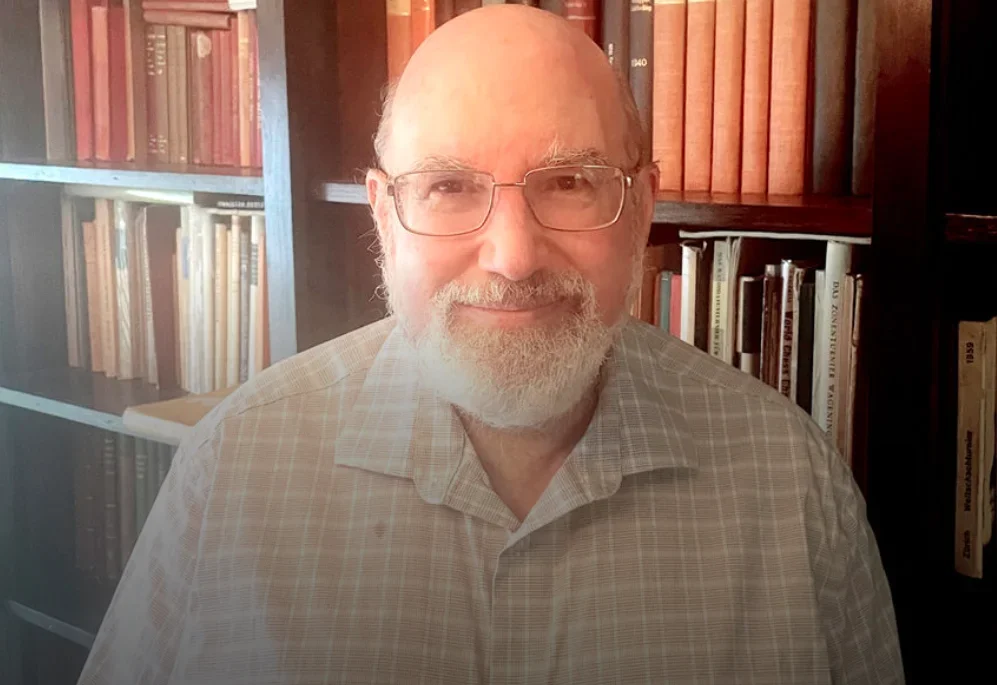
On October 16, over Zoom, Dr. Alexey Root and her son William Root interviewed the 2023 US Chess Grandmaster of the Year to find out more.
- Chess Life Online editor JJ Lang brought to our attention that Andy Woodward defeated Fabiano Caruana in a game where White played 41. f5, a move the engine did not have as one of its top choices. But once Woodward played the move, the engine gradually came around to liking it. How often does this scenario happen in correspondence chess when evaluating candidate moves? Are players who can intuit good moves quickly (and then check them with computers) advantaged in correspondence chess?
Edwards stated that Woodward’s move was suboptimal. But he emphasized that his opinion on what moves to play in correspondence games is not applicable to over-the-board chess.
In the correspondence game Edwards – Lobanov, 2017, after 11. ... Nc6, the engine doesn’t immediately realize that Black is losing. Yet White’s checkmating attack is devastating.
As discussed in a previous article by Edwards, 12. Bd3 was initially overlooked. “Humans and machines had missed the power of the move because, at first glance and at low depth, Black appears to win a piece after 12. Bd3 Qb6 13. Na4 Qa5+ 14. c3 Nxd4 15. Bxd4 b5, but it is only there that the position becomes clear after 16. Bxh7!!”
Playing months after Edwards won with 12. Bd3, former World Chess Champion GM Viswanathan Anand did not find 12. Bd3 over-the-board. “My great hero had missed this,” said Edwards in our Zoom call. Instead, Anand played 12.Qd2 in his 2018 draw with GM Vladislav Artemiev. To be fair to Anand, it took a brute force machine 35 days to find 12. Bd3. Edwards said, “The neural nets would find 12. Bd3 a little more quickly, but not instantly.”
- After your skepticism about computer engine evaluations in the 1990s, you left correspondence chess for a decade. Yet after coming back in the 2010s, you became one of the top players and then World Correspondence Chess Champion. How did you change your approach to allow computers to add value while still clearly adding more human value with your insights than did your opponents?
When Edwards returned to correspondence chess, he subjected his own repertoire to the same scrutiny with which he analyzed his opponents’ repertoires. For example, he gave up his beloved Hedgehog opening. Over Zoom, Edwards said, “I realized I needed to retool. My repertoire was suboptimal. A Hedgehog is suboptimal, apparently.”
At first, Edwards adopted former World Chess Champion GM Magnus Carlsen’s repertoire. But sometimes Carlsen stopped playing an opening after seven games or so. Now Edwards uses a Chinese Neural Net Database, which provides relative evaluations of every opening move and variation.
Edwards looks at his opponents’ games. ALL of their games. He figures out what books they study. For example, to defeat Carlos Cruzado Duenas, he guessed that Cruzado Duenas had read GM Vasilios Kotronias’ book The Sicilian Sveshnikov (Grandmaster Repertoire 18, Quality Chess, 2014). The Edwards – Cruzado Duenas game is lightly annotated here. Edwards wrote that Kotronias only “gives only 21. 0-0, which leads to a queen and opposite-colored bishop endgame. ... Instead, I played a novelty with 21. Rb5, which leads instead to a winning rook and opposite-colored bishop endgame.”
For more on Edwards’ rise to the top, see John Hartmann’s interview with Edwards, published shortly after the latter became World Correspondence Chess Champion.
- The methodological approach to playing correspondence chess correctly is not trivial or we would see minimal Elo differences between beginning correspondence players and champions. Have you or other correspondence chess players been effective at training people in this approach? What prerequisites should the trainee have? What is the training process like?
Eric Moskow is Edwards’ only trainee. Moskow went from a 1900-strength correspondence player to an ICCF rating of almost 2400 in under two years. Edwards set him up with the right databases and keeps them up to date. He informs Moskow of engine developments. As for prerequisites, Moskow understood how to build a repertoire and was an over-the-board US Chess master (and original life master) before he started training with Edwards.
To maximize the human advantage, Edwards advises keeping pieces on the board. He wrote, “the remaining main human hope may be to exploit small advantages with long-term maneuvering within fixed structures.”
In our Zoom call, he commented, “ChessBase is not an easy program to master.” He instructed Moskow on ChessBase usage. Recently, Edwards offered his ChessBase expertise to Marshall Chess Club members rated 1600 or higher.

- What lessons from your change in approach to chess engine use do you think are applicable to other fields attempting to use computers to help with decisions? Famously, Stanislav Petrov overrode a faulty computer system which told him to launch a retaliation nuclear strike in the 1980s. Unfortunately, he was demoted for overriding the computer, even though he was right and the computer was wrong. How do you think other sectors can incentivize humans to think critically about overriding computers?
Edwards said that neural nets are not going to destroy humanity, but they are making changes in every field. For example, AI is fast at examining medical records. However, he added, “If I am going to be operated on, I want a human involved.”
- Part of your role as a correspondence chess player is deciding which tools to use for each position. Your article states that you don’t use Stockfish, despite it likely being the strongest chess computer. Does Stockfish struggle with applying a methodological solution to chess on its own? To what extent does a skilled human taking the methodological approach have an edge over Stockfish at equal hardware and correspondence time controls?
At different points in a game, Edwards uses different tools. If a structure or an endgame is paramount, he searches ChessBase. Games in ICCF database, if filtered for games played by those rated 2400 and higher, are outstanding for research and preparation. Edwards said, “If I can conclude that my prospective opponent is a Stockfish user, then I am thrilled.” Stockfish didn’t fare well in the 120 test positions, compared with other engines.
- Your article discusses correspondence chess being a harbinger and a canary for technological progress. You also mention that in the 1980s engines were irrelevant in top level correspondence chess due to their inaccuracies. Are reports of LLMs hallucinating nuclear material on Chinese ships illustrating a similarity to 1980s chess engine blunders in correspondence chess, or is there another time period of correspondence chess you feel is more analogous to the current state of affairs of computer intelligence in the military?
The traditional model is for the commander-in-chief to weigh pros and cons, not for the military to make the decisions. Nowadays, the military turns decisions over to the neural net. And the neural net is not always right! The example given in the question is sufficient, and shows that we need humans.
- Besides chess players embracing piece-dropping chess family games (such as Shogi and bughouse), which never reduce to computer-solvable endgames, do you have other suggestions on minor rules tweaks that could keep correspondence chess exciting?
Edwards does not like mimicking Armageddon chess with time bidding, nor does he like games with material odds. And he doesn’t like the tiebreakers being proposed currently, such as the side ahead in material at the time of a draw gets extra tiebreaking points. Edwards said, “I don’t like mucking around with the game itself.”
About Jon Edwards
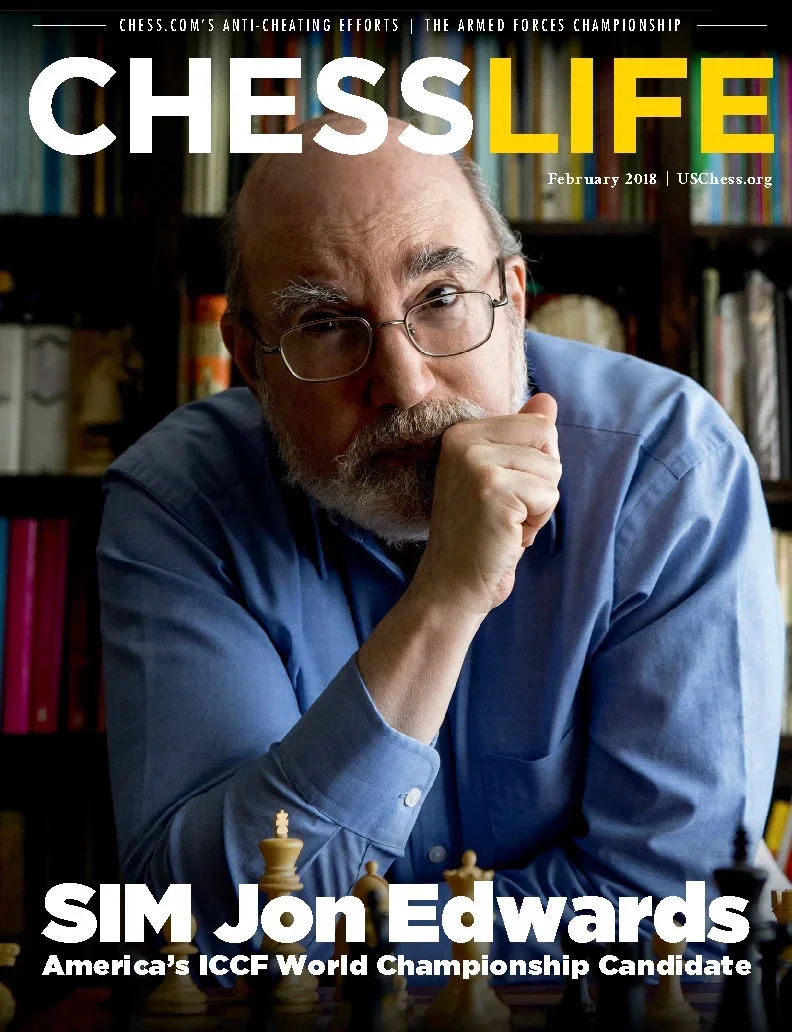
Some of Edwards’ chess accomplishments are listed below:
Correspondence Chess Olympiad, Bronze Medal, 2023
32nd World Correspondence Chess Champion, 2022
ICCF rating = 2552
Correspondence Chess Grandmaster, 2022
8th North American Invitational Correspondence Chess Championship, 1999, 1st place
10th United States Correspondence Championship, 1997, 1st place
Four-time winner of the APCT (American Postal Chess Tournaments) Championship
APCT Game of the Year Award, 1996, 1997


Categories
Archives
- October 2026 (23)
- September 2026 (26)
- August 2026 (28)
- July 2026 (36)
- June 2026 (32)
- May 2026 (30)
- April 2026 (33)
- March 2026 (27)
- February 2026 (24)
- January 2026 (24)
- December 2025 (27)
- November 2025 (29)
- October 2025 (39)
- September 2025 (27)
- August 2025 (29)
- July 2025 (43)
- June 2025 (25)
- May 2025 (24)
- April 2025 (29)
- March 2025 (29)
- February 2025 (20)
- January 2025 (24)
- December 2024 (34)
- November 2024 (18)
- October 2024 (35)
- September 2024 (23)
- August 2024 (27)
- July 2024 (44)
- June 2024 (27)
- May 2024 (31)
- April 2024 (51)
- March 2024 (34)
- February 2024 (24)
- January 2024 (26)
- December 2023 (29)
- November 2023 (26)
- October 2023 (37)
- September 2023 (27)
- August 2023 (37)
- July 2023 (47)
- June 2023 (33)
- May 2023 (37)
- April 2023 (45)
- March 2023 (37)
- February 2023 (28)
- January 2023 (31)
- December 2022 (23)
- November 2022 (32)
- October 2022 (31)
- September 2022 (19)
- August 2022 (39)
- July 2022 (32)
- June 2022 (35)
- May 2022 (21)
- April 2022 (31)
- March 2022 (33)
- February 2022 (21)
- January 2022 (27)
- December 2021 (36)
- November 2021 (34)
- October 2021 (25)
- September 2021 (25)
- August 2021 (41)
- July 2021 (36)
- June 2021 (29)
- May 2021 (29)
- April 2021 (31)
- March 2021 (33)
- February 2021 (28)
- January 2021 (29)
- December 2020 (38)
- November 2020 (40)
- October 2020 (41)
- September 2020 (35)
- August 2020 (38)
- July 2020 (36)
- June 2020 (46)
- May 2020 (42)
- April 2020 (37)
- March 2020 (60)
- February 2020 (38)
- January 2020 (45)
- December 2019 (34)
- November 2019 (35)
- October 2019 (42)
- September 2019 (45)
- August 2019 (56)
- July 2019 (44)
- June 2019 (35)
- May 2019 (40)
- April 2019 (48)
- March 2019 (61)
- February 2019 (39)
- January 2019 (30)
- December 2018 (29)
- November 2018 (51)
- October 2018 (45)
- September 2018 (29)
- August 2018 (49)
- July 2018 (35)
- June 2018 (31)
- May 2018 (39)
- April 2018 (31)
- March 2018 (26)
- February 2018 (33)
- January 2018 (30)
- December 2017 (26)
- November 2017 (24)
- October 2017 (30)
- September 2017 (30)
- August 2017 (32)
- July 2017 (27)
- June 2017 (32)
- May 2017 (26)
- April 2017 (37)
- March 2017 (28)
- February 2017 (30)
- January 2017 (27)
- December 2016 (29)
- November 2016 (24)
- October 2016 (32)
- September 2016 (31)
- August 2016 (27)
- July 2016 (24)
- June 2016 (26)
- May 2016 (19)
- April 2016 (30)
- March 2016 (37)
- February 2016 (27)
- January 2016 (33)
- December 2015 (25)
- November 2015 (23)
- October 2015 (16)
- September 2015 (28)
- August 2015 (28)
- July 2015 (6)
- June 2015 (1)
- May 2015 (2)
- April 2015 (1)
- February 2015 (3)
- January 2015 (1)
- December 2014 (1)
- July 2010 (1)
- October 1991 (1)
- August 1989 (1)
- January 1988 (1)
- December 1983 (1)