


After the dramatic opening day of the 2026 FIDE Candidates tournament, a respite was much needed. In one sense, this was attained — all eight games ended in draws — but in all other senses the drama was only heightened.
This round had time scrambles and blunders aplenty. The more peaceful games, too, turned out to have quite subtle and interesting moments when viewed under the microscope. So the outwardly dry nature of the round turned out — as is usual — to be a mirage.
For American fans, there was quite a bit to worry about in the opening hours of the round. Top seed GM Hikaru Nakamura, taking the black pieces for the second game in a row, seemed to be strategically worse against Russian GM Andrey Esipenko with few chances of counterplay.


However, Nakamura’s defensive effort and fortitude was extremely impressive. After a certain point, he found every single key move and gave his opponent no hint of winning chances.
Nakamura is an expert in rook endgames (well, not just in rook endgames!) and this was on fine display today. Take special note of how he handled the endgame after move 40. Such rook endings (with equal pawns on the kingside and an outside passed pawn on the a-file) are very tricky, yet Hikaru defended this one absolutely perfectly.


The other American in the field, GM Fabiano Caruana, showed ambition even as Black by choosing the unusual 3. … Nd7!? in the Queen’s Gambit Declined. His opponent, Dutch GM Anish Giri, did not seem surprised but nevertheless failed to gain much of an edge, and Caruana was never in objective trouble.
The other two games — Chinese GM Wei Yi against Indian GM Praggnanandhaa Rameshbabu and Uzbek GM Javokhir Sindarov against German GM Matthias Bluebaum — followed the same pattern: One player gained a positional advantage, but failed to make the correct structural decision at the key moment, and could not break though his opponent’s stern resistance.
The games in the Women’s section had a completely different character. The shorter time control in the first phase of the game meant that time trouble played a decisive factor, and, as Korchnoi used to say, there are no heroes in time trouble.
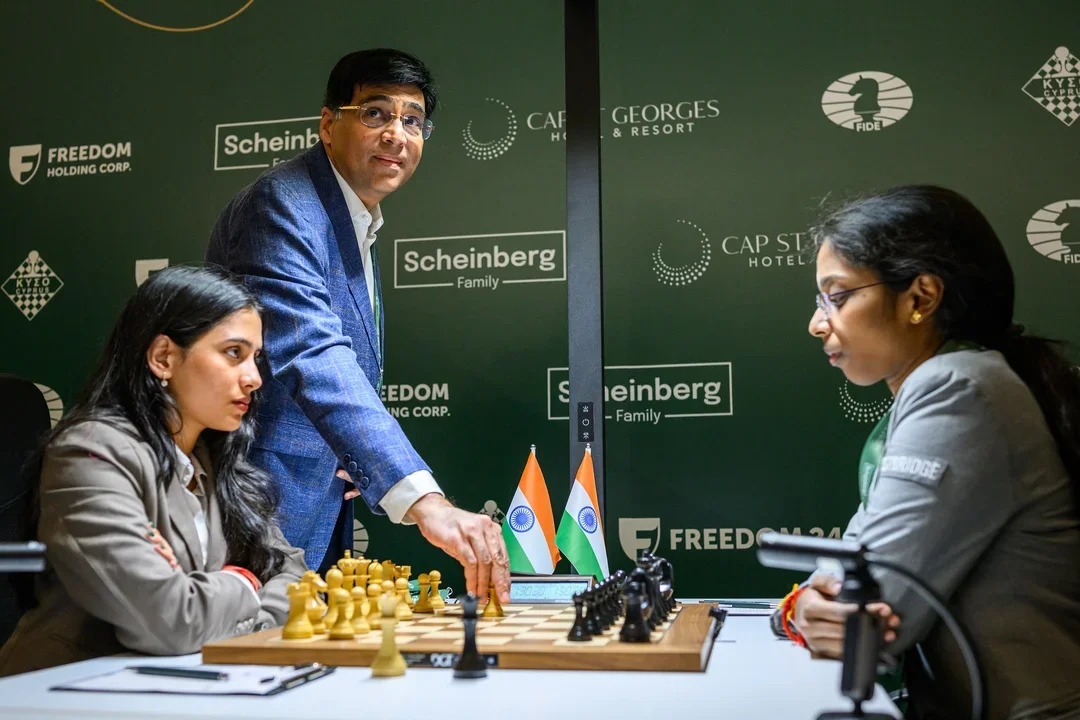
Indian GM Divya Deshmukh’s game against her countrywoman GM Vaishali Rameshbabu started off as a quiet but well-played Queen’s Gambit Declined. Until the final moments of the time control, the position remained nearly level. Then, a surprising blunder by Vaishali totally upset the balance.

The rest is best explained in chess notation, not in words:
A similar fate befell Chinese GM Zhu Jiner, who accepted an early pawn sacrifice against Russian GM Kateryna Lagno and went on to outplay her experienced opponent.

Just when victory seemed in reach, a move played with only three seconds left on the clock ruined all of Zhu’s efforts…

The remaining two games were, thankfully, calmer. The Petroff Defense’s reputation for solidity did not fail Chinese GM Tan Zhongyi, who drew without any trouble against Ukrainian GM Anna Muzychuk:
Lastly, Kazakh GM Bibisara Assaubayeva’s game against Russian GM Aleksandra Goryachkina was well-played by both sides, and also of some theoretical interest:
Round 3 is currently underway, with Round 4 scheduled for tomorrow at 8:45 a.m. EDT. A rest day follows on Thursday.
Quick Links
Round-by-Round Coverage on Chess Life Online


Categories
Archives
- October 2026 (9)
- September 2026 (27)
- August 2026 (28)
- July 2026 (36)
- June 2026 (32)
- May 2026 (30)
- April 2026 (33)
- March 2026 (27)
- February 2026 (24)
- January 2026 (24)
- December 2025 (27)
- November 2025 (29)
- October 2025 (39)
- September 2025 (27)
- August 2025 (29)
- July 2025 (43)
- June 2025 (25)
- May 2025 (24)
- April 2025 (29)
- March 2025 (29)
- February 2025 (20)
- January 2025 (24)
- December 2024 (34)
- November 2024 (18)
- October 2024 (35)
- September 2024 (23)
- August 2024 (27)
- July 2024 (44)
- June 2024 (27)
- May 2024 (31)
- April 2024 (51)
- March 2024 (34)
- February 2024 (24)
- January 2024 (26)
- December 2023 (29)
- November 2023 (26)
- October 2023 (37)
- September 2023 (27)
- August 2023 (37)
- July 2023 (47)
- June 2023 (33)
- May 2023 (37)
- April 2023 (45)
- March 2023 (37)
- February 2023 (28)
- January 2023 (31)
- December 2022 (23)
- November 2022 (32)
- October 2022 (31)
- September 2022 (19)
- August 2022 (39)
- July 2022 (32)
- June 2022 (35)
- May 2022 (21)
- April 2022 (31)
- March 2022 (33)
- February 2022 (21)
- January 2022 (27)
- December 2021 (36)
- November 2021 (34)
- October 2021 (25)
- September 2021 (25)
- August 2021 (41)
- July 2021 (36)
- June 2021 (29)
- May 2021 (29)
- April 2021 (31)
- March 2021 (33)
- February 2021 (28)
- January 2021 (29)
- December 2020 (38)
- November 2020 (40)
- October 2020 (41)
- September 2020 (35)
- August 2020 (38)
- July 2020 (36)
- June 2020 (46)
- May 2020 (42)
- April 2020 (37)
- March 2020 (60)
- February 2020 (38)
- January 2020 (45)
- December 2019 (34)
- November 2019 (35)
- October 2019 (42)
- September 2019 (45)
- August 2019 (56)
- July 2019 (44)
- June 2019 (35)
- May 2019 (40)
- April 2019 (48)
- March 2019 (61)
- February 2019 (39)
- January 2019 (30)
- December 2018 (29)
- November 2018 (51)
- October 2018 (45)
- September 2018 (29)
- August 2018 (49)
- July 2018 (35)
- June 2018 (31)
- May 2018 (39)
- April 2018 (31)
- March 2018 (26)
- February 2018 (33)
- January 2018 (30)
- December 2017 (26)
- November 2017 (24)
- October 2017 (30)
- September 2017 (30)
- August 2017 (32)
- July 2017 (27)
- June 2017 (32)
- May 2017 (26)
- April 2017 (37)
- March 2017 (28)
- February 2017 (30)
- January 2017 (27)
- December 2016 (29)
- November 2016 (24)
- October 2016 (32)
- September 2016 (31)
- August 2016 (27)
- July 2016 (24)
- June 2016 (26)
- May 2016 (19)
- April 2016 (30)
- March 2016 (37)
- February 2016 (27)
- January 2016 (33)
- December 2015 (25)
- November 2015 (23)
- October 2015 (16)
- September 2015 (28)
- August 2015 (28)
- July 2015 (6)
- June 2015 (1)
- May 2015 (2)
- April 2015 (1)
- February 2015 (3)
- January 2015 (1)
- December 2014 (1)
- July 2010 (1)
- October 1991 (1)
- August 1989 (1)
- January 1988 (1)
- December 1983 (1)