

Editor's note: this story first appeared in the February 2026 issue of Chess Life magazine. A reduced size pdf of the magazine article is available to accompany this online version.
Consider becoming a US Chess member for more content like this — access to digital editions of both Chess Life and Chess Life Kids is a member benefit, and you can receive print editions of both magazines for a small add-on fee.
Ask a chessplayer to pick today’s important endgame theorist, and chances are they’ll say Mark Dvoretsky, whose eponymous Dvoretsky’s Endgame Manual has become one of the most recommended (if less often fully read) books among today’s elite.
Some will prefer Karsten Müller, with Fundamental Chess Endings (co-written with Frank Lamprecht) and How to Play Chess Endgames (with Wolfgang Pajeken) often recommended to serious students. Müller is also one of the current team behind the latest Dvoretsky’s Endgame Manual, now in a heavily updated sixth edition.
Old heads will argue that Averbakh’s five-volume Comprehensive Chess Endings is still the best teaching series. Rook ending aficionados might reach for Smyslov and Levenfish’s Rook Endings, but only the descriptive version — the algebraic one is full of typos. And you’ll still find those who recall Reuben Fine’s Basic Chess Endings with more than a bit of nostalgia.
But endgame theory does not stop moving, and with today’s technology corrections are made and discoveries found all the time. The most interesting work in endgame theory today might be coming from an untitled Armenian who spends his free time posting to message boards and whom both Dvoretsky and Müller have regularly cited.
I first encountered Vardan Poghosyan in the Chesspub.com endgame forums almost 15 years ago, where he, along with a handful of others, has been publishing scrupulously detailed analyses. His discoveries in a number of key positions have rewritten chunks of rook endgame theory, and in recent months he has turned his attention to correcting analyses by Gelfand and Shereshevsky.
I asked Poghosyan to tell us a little about himself and his chess origin story. He also takes us inside his chess laboratory to look at two of his key discoveries as well as a recent endgame composition based on his studies.
JH: Could you tell Chess Life readers a bit about yourself?
VP: I was born in 1965 in the village of Verin Artashat, about 40 kilometers (about 25 miles) from Yerevan. I learned chess at age 9 from my father, who at 94 still enjoys the game. Chess literature was hard to obtain in Soviet Armenia, so my first real source of instruction was Chess Armenia magazine. In 1976 I earned the fourth category norm through its solving competition, and a year later the third category norm through a correspondence school run by Viktor Henkin in Komsomolskaya Pravda. After joining the Yerevan Chess School, I achieved the first category norm in 1980.
Chess fascinated me, but I was equally drawn to history and international politics. In the ninth grade I decided to focus on preparing for the elite Moscow State Institute of International Relations (MGIMO). After considerable effort I was admitted and graduated with distinction in 1991, though I chose not to become a diplomat.
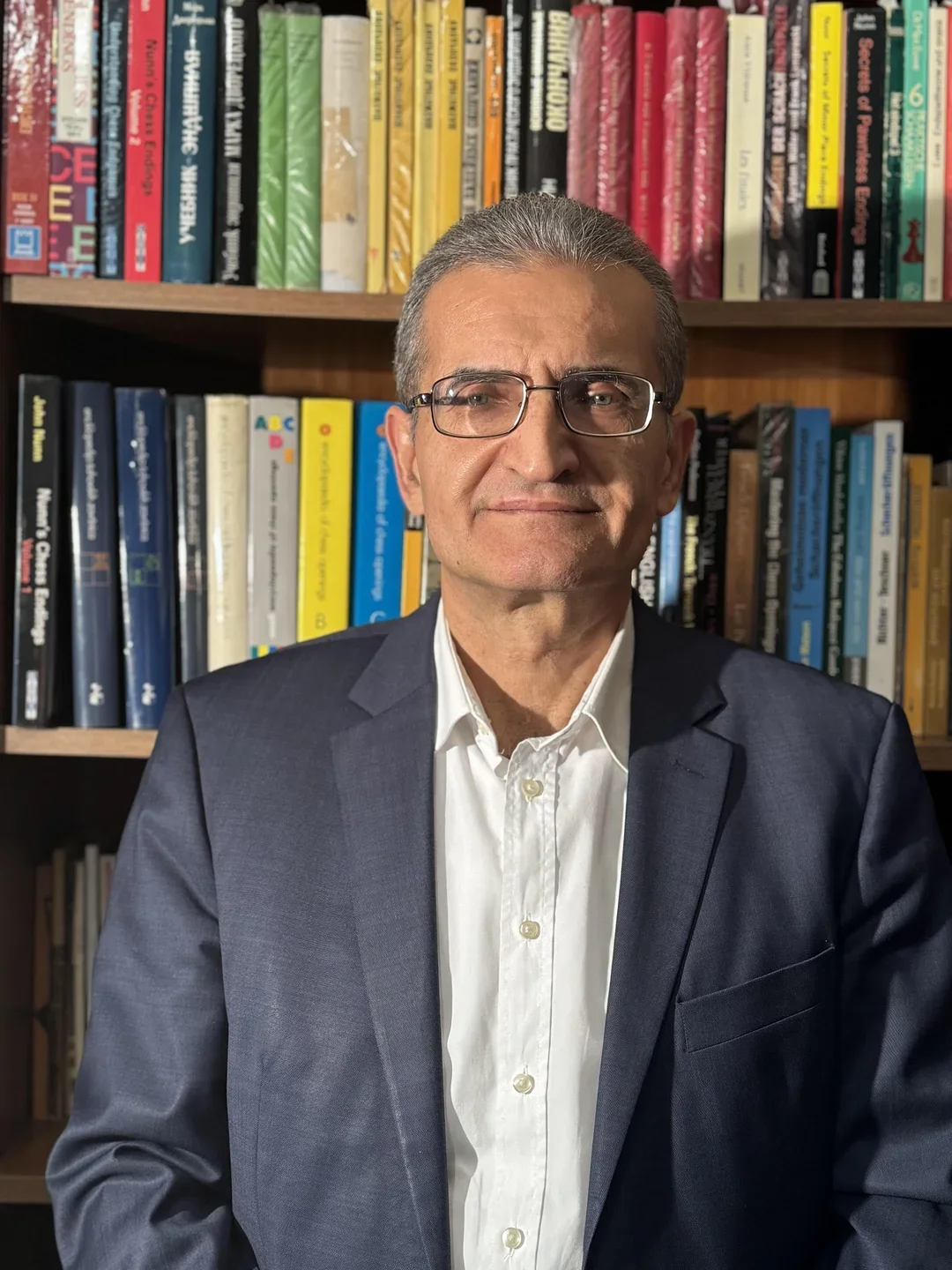
Following the Soviet Union’s collapse, I pursued a second degree at the University of Bonn, studying political science and public law. I returned to Armenia in 1999 and worked for 20 years as team leader of the GIZ Legal Program, contributing to numerous legislative projects. I was also one of the principal authors of Armenia’s fully revised 2015 Constitution.
JH: How did you become interested in endgame theory?
VP: My renewed interest began when my three sons started playing chess and attending the Yerevan Chess School. Unlike in my childhood, chess literature had become widely available, and I gradually built a large library. It was Dvoretsky’s Endgame Manual, however, that truly reignited my fascination with rook endings. Later, watching the 2010 Sasikiran – Aronian game online had a profound impact: A theoretically simple draw turned into a painful loss for my friend Levon. This encounter pushed me to examine rook endings much more deeply.
JH: How do you do your analysis?
VP: While working through Dvoretsky’s manual, I analyzed the Capablanca – Yates ending over the board and found the move 6. e6, which engines confirmed was winning. This contradicted decades of accepted theory and encouraged me to re-examine much of the literature with a critical eye.
VP: One of my most important findings was in the Kantorovich position.
VP: From the start I doubted the traditional capture on f2 and believed Black should seek immediate counterplay. Modern engines and 7-piece tablebases now make it possible to analyze theoretical endings with remarkable precision. This accuracy finally allows us to establish reliable principles and generalizations that can be taught systematically — something I see as central to my work.
I am also interested in the historical development of rook endgame theory. The American mathematician Orrin Frink, for example, made contributions that deserve far wider recognition, and I am preparing an article on his work.
JH: Why should practical players study endgame theory?
VP: For anyone who plays competitively, endgame knowledge is essential. Even elite players commit serious mistakes under time pressure in positions they could handle with better theoretical grounding.
The Sasikiran – Aronian game is a perfect example: Levon lost because he was unfamiliar with a principle known since Chéron — that in certain rook and pawn versus rook endings, the defending king must advance toward the fifth or sixth rank, not retreat.
I believe that adjournments slowed theoretical progress in years gone by; players assumed they could analyze endings at home. With today’s rapid and accelerated time controls, such luxury no longer exists. Deep endgame knowledge wins games.
JH: What are your favorite chess books? Do you plan to publish your own?
VP: It’s difficult to single out one favorite. Among theoretical works on rook endings, I especially value the first edition of Averbakh’s volume, written by the superb analyst Nikolay Kopaev. Although never translated into English, a German edition exists. I also appreciate Averbakh’s two-volume German-language endgame textbook, which presents 263 rook endings in a very clear and methodical way.
At a more introductory level, I recommend de la Villa, Silman, and Averbakh’s Essential Knowledge. And of course, the work closest to my heart is Dvoretsky’s manual, continually refined by Karsten Müller and GM Alex Fishbein.
Between 2011 and 2012 I exchanged extensive correspondence with Mark Dvoretsky. I sent him analyses; he sent revised drafts of his manual, and I commented on them. After our work on specific positions, I submitted methodological observations on his rook endgame chapter. I also shared a long study on cutting off the king along files, proposing revised formulations of rules introduced by Chéron and later modified by Kopaev. Dvoretsky wrote that the study was “too large for a journal or website” and suggested preparing a full book that integrated my findings. He believed such a book “would certainly be noticed and influence future publications.”
At the time my professional workload made this impossible, especially once I joined the Constitutional Commission in 2013. Today, however, the idea feels more realistic. My analyses continue to grow rapidly — though I am still deciding whether to publish a single comprehensive volume or release material in stages.
By way of conclusion, and as an example of how practical play can influence art and theory, I can offer a study I composed after analyzing Potapov – Shubin (Russian Rapid Ch, 2019). In the game, Black chose the natural-looking 44. ... Rb8? and lost, whereas the precise 44. ... Rd8! would have saved the day in true study-like fashion.
Who was Orrin Frink?
Orrin Frink Jr. (1901-1988) was an important 20th-century mathematician who introduced the concept of the Frink ideal. He taught at Penn State for more than 40 years after earning his doctorate in mathematics from Columbia in 1926 or 1927.
But mathematics was not Frink’s only interest. He was a regular in the New York chess scene in the 1920s and likely (based on results and historical reconstruction) at least a master-strength player. Perhaps his best result was at the 1924 Manhattan Chess Club Championship, where he shared third place with an aged David Janowsky. Here’s his game from that event with another star in Caïssa’s pantheon, Carlos Torre Repetto.
This fine save is emblematic of Frink’s broader interest in the endgame. He regularly published problems, studies, and endgame analyses from 1919 through 1928, mostly in The Chess Amateur, including a study that anticipated a famous Vancura position attributed to Romanovsky in 1950.
But that’s not to say that Frink couldn’t play attacking chess. Check out this fine miniature published in the February 1920 issue of American Chess Bulletin.
Editor’s note: As an online exclusive, readers may be interested to peruse 14 additional largely unknown games of Frink originally published in The Chess Amateur. All games are in the study for this article, beginning at this chapter. Of them, the following French dismantlement was particularly impressive, so I added some annotations.


Categories
Archives
- October 2026 (9)
- September 2026 (27)
- August 2026 (28)
- July 2026 (36)
- June 2026 (32)
- May 2026 (30)
- April 2026 (33)
- March 2026 (27)
- February 2026 (24)
- January 2026 (24)
- December 2025 (27)
- November 2025 (29)
- October 2025 (39)
- September 2025 (27)
- August 2025 (29)
- July 2025 (43)
- June 2025 (25)
- May 2025 (24)
- April 2025 (29)
- March 2025 (29)
- February 2025 (20)
- January 2025 (24)
- December 2024 (34)
- November 2024 (18)
- October 2024 (35)
- September 2024 (23)
- August 2024 (27)
- July 2024 (44)
- June 2024 (27)
- May 2024 (31)
- April 2024 (51)
- March 2024 (34)
- February 2024 (24)
- January 2024 (26)
- December 2023 (29)
- November 2023 (26)
- October 2023 (37)
- September 2023 (27)
- August 2023 (37)
- July 2023 (47)
- June 2023 (33)
- May 2023 (37)
- April 2023 (45)
- March 2023 (37)
- February 2023 (28)
- January 2023 (31)
- December 2022 (23)
- November 2022 (32)
- October 2022 (31)
- September 2022 (19)
- August 2022 (39)
- July 2022 (32)
- June 2022 (35)
- May 2022 (21)
- April 2022 (31)
- March 2022 (33)
- February 2022 (21)
- January 2022 (27)
- December 2021 (36)
- November 2021 (34)
- October 2021 (25)
- September 2021 (25)
- August 2021 (41)
- July 2021 (36)
- June 2021 (29)
- May 2021 (29)
- April 2021 (31)
- March 2021 (33)
- February 2021 (28)
- January 2021 (29)
- December 2020 (38)
- November 2020 (40)
- October 2020 (41)
- September 2020 (35)
- August 2020 (38)
- July 2020 (36)
- June 2020 (46)
- May 2020 (42)
- April 2020 (37)
- March 2020 (60)
- February 2020 (38)
- January 2020 (45)
- December 2019 (34)
- November 2019 (35)
- October 2019 (42)
- September 2019 (45)
- August 2019 (56)
- July 2019 (44)
- June 2019 (35)
- May 2019 (40)
- April 2019 (48)
- March 2019 (61)
- February 2019 (39)
- January 2019 (30)
- December 2018 (29)
- November 2018 (51)
- October 2018 (45)
- September 2018 (29)
- August 2018 (49)
- July 2018 (35)
- June 2018 (31)
- May 2018 (39)
- April 2018 (31)
- March 2018 (26)
- February 2018 (33)
- January 2018 (30)
- December 2017 (26)
- November 2017 (24)
- October 2017 (30)
- September 2017 (30)
- August 2017 (32)
- July 2017 (27)
- June 2017 (32)
- May 2017 (26)
- April 2017 (37)
- March 2017 (28)
- February 2017 (30)
- January 2017 (27)
- December 2016 (29)
- November 2016 (24)
- October 2016 (32)
- September 2016 (31)
- August 2016 (27)
- July 2016 (24)
- June 2016 (26)
- May 2016 (19)
- April 2016 (30)
- March 2016 (37)
- February 2016 (27)
- January 2016 (33)
- December 2015 (25)
- November 2015 (23)
- October 2015 (16)
- September 2015 (28)
- August 2015 (28)
- July 2015 (6)
- June 2015 (1)
- May 2015 (2)
- April 2015 (1)
- February 2015 (3)
- January 2015 (1)
- December 2014 (1)
- July 2010 (1)
- October 1991 (1)
- August 1989 (1)
- January 1988 (1)
- December 1983 (1)