


OAXTEPEC, MEXICO — After several years of prime travel locations (Dominican Republic, Medellín, Colombia, and Iguazu Falls, Brazil), FIDE Americas chose a smaller, relatively unknown locale for the 2026 edition of the American Continental Championship. Indeed, despite competing for 10 days in Oaxtepec, I’m still not sure how to pronounce the town’s name.
The main attraction was the Six Flags Hurricane Harbor amusement park conveniently situated across from the hotel — the Dorados Conventions & Resort — and the town’s small bus terminal. To compensate, the Dorados Resort offered six outdoor pools, a fading tennis court, and an underutilized track.
Nevertheless, few chess players took advantage of the amenities, perhaps due to lack of trust in the aging infrastructure. But the resort wasn't the main draw, anyways. That would be the four qualification spots in the 2027 FIDE World Cup.

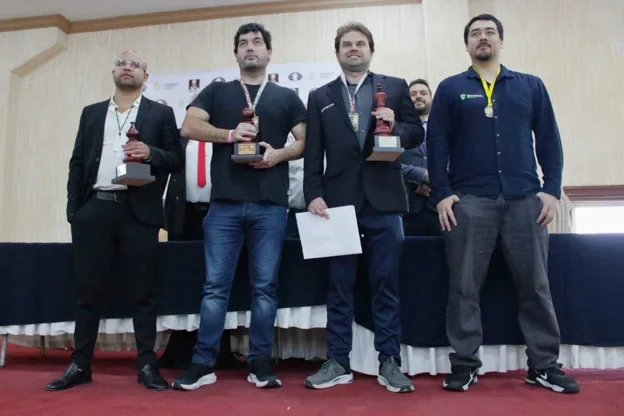
With a dearth of daytime endeavors, GM Sam Shankland remained fully locked in and defended his title from last year with a dominant 9½/11 score, a clear point-and-a-half ahead of the field. Five players tied for second with 8/11. Of them, GMs Juan Obregon of Mexico, Sandro Mareco of Argentina, and Alexandr Fier of Brazil also qualified for the World Cup on tiebreaks.
Only five Americans were in attendance this year, with Shankland being the top seed. This year’s reduced representation was a feature across the board; 126 players in attendance accounted for around half of last year’s attendance and only a third of the total attendance in 2024. In this reduced field, I managed a 10th place finish on 7½ points, on par with my relatively high starting position as the 11th seed. WGM Thalia Cervantes finished on a 6/11 score, placing second among women in the event.
One of the event’s biggest sensations was Costa Rican IM Emanuel Jimenez Garcia, who earned his final GM norm at a modest rating of 2349. He also not-so-discreetly drew the attention of the tournament’s fair play enforcers, who constantly hovered around his board. Nevertheless, this additional scrutiny turned up nothing. Given the very thorough fair play scan conducted at the beginning of each round, this was hardly surprising.


On the other hand, my decently strong finish was anything but sensational, marked by early setbacks. In the second round, after violating several basic chess principles, I found myself in a losing position straight out of the opening. Below is my review of the painful, brief, but admittedly instructive game.
As a reward for collapsing in spectacular fashion, I faced several more rounds against lower-rated opposition. But the relief I experienced after my clean bounce-back win in Round 3 proved temporary; I barely managed a draw in the following round before failing to convert in Round 5.
I wasn’t alone in my Round 5 disappointment: Shankland’s opportunity to maintain his perfect score slipped through his fingers.
After this loss, in order to conserve energy in the second round of the day, Shankland agreed to a quick draw against Fier as Black, temporarily ceding the tournament lead to Obregon. This decision proved prescient as he rebounded with a three-game winning streak.
The final game of the trio came in Round 9 against GM Sion Galaviz of Mexico, effectively clinching a World Cup qualification spot. Leaving nothing to chance, Shankland put on a masterclass of his 2700+ level opening preparation with a deep Exchange sacrifice on move 18 of a relatively calm Rossilimo.
The second half of my tournament also seemed to be turning around after a rough start. I had managed to win against a pair of Colombian players before facing IM Lennis Martinez of Cuba in Round 8. Even though I was still down some rating, I had kept myself in the hunt with 5/7, (unintentionally) Swiss gambit style. A win in this game would’ve set me up well for a shot at a World Cup qualification spot.
When I arrived to the board, I was surprised to see that my clock, as Black, had started even as it appeared that White had yet to make his first move. I sat down and tentatively offered my hand, unsure if I was seeing things in my rush to the board. Everything seemed normal, even as my opponent hurriedly made his first move, 1. d4. At this point, I became thoroughly perplexed. Why had my opponent, a seasoned IM, started my clock without moving? Surely, this had to be a mistake, or perhaps my back pain made my judgment foggy, or the day’s downpour had left me delirious.
Trying my best to ignore what was plausibly a large and potentially voluntary indiscretion, I carried on as normal. Calling the arbiter for an incident that didn’t seem to materially change anything felt overly confrontational and unnecessary. It’s a small deal, I told myself. But I couldn’t fully shake the feeling that somehow, something was amiss. The psychological games continued as my opponent blitzed out a novelty and began flexing his muscles every couple of moves. Obnoxious, but not killer. If anything, I was even more determined to win. Fortunately, the game was much more interesting than my opponent’s attempts to throw me off, though unfortunately I lost on a simple blunder late in the game.
After we left the playing hall, I asked Martinez why he had started my clock without moving. Indignantly, he stated that he did not want me to gain a preparation advantage by seeing his move on the broadcast (which was on a 15-minute delay). He claimed that he was allowed to start my clock without making a move as long as he wrote down his intended move on the notation sheet. He shared that he had executed the same tactic at “several” European tournaments, challenging me to ask the arbiters.
Unconvinced by his convoluted and head-scratching excuse, I accepted his challenge and sought clarification from the arbiters. They appeared as confused as I was, asking me to repeat the story at dinner, and eventually confirmed my suspicions that my opponent’s story was as solid as a piece of soggy toilet paper.
In the last round, I happened to be playing across from Martinez. Early into the game, he stood up and pointedly exclaimed (at full volume) for me to look and see that his trick, which he decided to employ again against a Mexican GM, was completely allowed. I simply shook my head, a silent rebuke to the mid-game disruption.
When the GM finally arrived, a trio of arbiters swarmed the board and paused the game, eliciting a heated reaction from Martinez and prompting a prophylactic appearance by the hotel security. Despite Martinez’s best efforts to convince the arbiters, using the same “preparation” argument, he was ultimately reprimanded and given a small time penalty. All personal feelings aside, I still couldn’t believe that he tried to employ the same trick against a GM.
A stopped clock might be right twice a day, but a prematurely hit clock is not.
One of the reasons I love playing the Continental is that it always brings unique experiences. Fortunately, this year’s highlights were not all as…charged as the above anecdote.
For one, I had the pleasure of sitting down with my friend IM Diego Flores Quillas from Peru to discuss the recent, closely contested Peruvian election that was unfolding as we were playing in the tournament. He explained the political environment and the history of elections decided on razor-thin margins. After this year’s election, Peru will have had ten presidents in as many years. Interestingly, cities in Peru tend to vote for more conservative candidates while rural areas overwhelmingly support populist and left-wing candidates.
Maybe it wasn’t as thrilling as Six Flags, but our conversation was a pleasant excursion from the grueling world of chess, and it was exactly the sort of experience I look forward to when traveling to this event.
Best of luck to Shankland in the 2027 FIDE World Cup. After reaching the quarterfinals in both 2021 and 2025, maybe this will be the cycle he breaks through!


Categories
Archives
- October 2026 (7)
- September 2026 (27)
- August 2026 (28)
- July 2026 (36)
- June 2026 (32)
- May 2026 (30)
- April 2026 (33)
- March 2026 (27)
- February 2026 (24)
- January 2026 (24)
- December 2025 (27)
- November 2025 (29)
- October 2025 (39)
- September 2025 (27)
- August 2025 (29)
- July 2025 (43)
- June 2025 (25)
- May 2025 (24)
- April 2025 (29)
- March 2025 (29)
- February 2025 (20)
- January 2025 (24)
- December 2024 (34)
- November 2024 (18)
- October 2024 (35)
- September 2024 (23)
- August 2024 (27)
- July 2024 (44)
- June 2024 (27)
- May 2024 (31)
- April 2024 (51)
- March 2024 (34)
- February 2024 (24)
- January 2024 (26)
- December 2023 (29)
- November 2023 (26)
- October 2023 (37)
- September 2023 (27)
- August 2023 (37)
- July 2023 (47)
- June 2023 (33)
- May 2023 (37)
- April 2023 (45)
- March 2023 (37)
- February 2023 (28)
- January 2023 (31)
- December 2022 (23)
- November 2022 (32)
- October 2022 (31)
- September 2022 (19)
- August 2022 (39)
- July 2022 (32)
- June 2022 (35)
- May 2022 (21)
- April 2022 (31)
- March 2022 (33)
- February 2022 (21)
- January 2022 (27)
- December 2021 (36)
- November 2021 (34)
- October 2021 (25)
- September 2021 (25)
- August 2021 (41)
- July 2021 (36)
- June 2021 (29)
- May 2021 (29)
- April 2021 (31)
- March 2021 (33)
- February 2021 (28)
- January 2021 (29)
- December 2020 (38)
- November 2020 (40)
- October 2020 (41)
- September 2020 (35)
- August 2020 (38)
- July 2020 (36)
- June 2020 (46)
- May 2020 (42)
- April 2020 (37)
- March 2020 (60)
- February 2020 (38)
- January 2020 (45)
- December 2019 (34)
- November 2019 (35)
- October 2019 (42)
- September 2019 (45)
- August 2019 (56)
- July 2019 (44)
- June 2019 (35)
- May 2019 (40)
- April 2019 (48)
- March 2019 (61)
- February 2019 (39)
- January 2019 (30)
- December 2018 (29)
- November 2018 (51)
- October 2018 (45)
- September 2018 (29)
- August 2018 (49)
- July 2018 (35)
- June 2018 (31)
- May 2018 (39)
- April 2018 (31)
- March 2018 (26)
- February 2018 (33)
- January 2018 (30)
- December 2017 (26)
- November 2017 (24)
- October 2017 (30)
- September 2017 (30)
- August 2017 (32)
- July 2017 (27)
- June 2017 (32)
- May 2017 (26)
- April 2017 (37)
- March 2017 (28)
- February 2017 (30)
- January 2017 (27)
- December 2016 (29)
- November 2016 (24)
- October 2016 (32)
- September 2016 (31)
- August 2016 (27)
- July 2016 (24)
- June 2016 (26)
- May 2016 (19)
- April 2016 (30)
- March 2016 (37)
- February 2016 (27)
- January 2016 (33)
- December 2015 (25)
- November 2015 (23)
- October 2015 (16)
- September 2015 (28)
- August 2015 (28)
- July 2015 (6)
- June 2015 (1)
- May 2015 (2)
- April 2015 (1)
- February 2015 (3)
- January 2015 (1)
- December 2014 (1)
- July 2010 (1)
- October 1991 (1)
- August 1989 (1)
- January 1988 (1)
- December 1983 (1)